
DC vs AC Cooling Pumps for Data Centers: A Complete Comparison
Published:2026-10-26
The short answer is decided by where the pump sits: use a brushless DC cooling pump inside rack-level CDUs and server loops, and use a 380 V AC multistage cooling pump in the facility plant room and distribution network. The two pump classes do not compete — they divide the building by flow scale, voltage, and head. DC pumps move liters per minute at 12–48 V; AC multistage pumps move cubic meters per hour at 380 V. This comparison lays out the trade-offs side by side and shows how the two tiers work together.
The Bottom Line by Tier
Dimension | Brushless DC pump | AC multistage pump |
Voltage | 12 V / 24 V / 48 V | 380 V (three-phase) |
Flow scale | Liters per minute (6–30 L/min) | Cubic meters per hour (3–72 m³/h) |
Typical head | 3–27 m | 15–40 m |
Rated power | 10–100 W | 800 W–7.5 kW |
Sits in | Rack CDU, server loop | Plant room, distribution manifold |
Control | Variable speed, compact | Fixed-speed or VFD, high-power |
Read the table as a routing rule: if your circuit lives inside a rack, it is a DC decision; if it spans the hall, it is an AC decision.
Why Brushless DC Pumps Win Inside the Rack
Inside a rack-level CDU, space is tight and the loop is short, so compactness and controllability matter more than raw flow. DC brushless pumps fit that envelope:
They run on the same low-voltage bus as the rack — 12 V legacy, 24 V mainstream, 48 V OCP/AI.
Their flow and head match single-rack loads. The P4552 (24 V, 11 L/min, 11 m, 28 W) covers light loops, and the P6092 (24 V, 25 L/min, 27 m, 88 W) covers high-head dual-rack loops.
They are easy to vary with a control signal, which matters because pump speed directly affects PUE.
Why AC Multistage Pumps Win in the Plant Room
Facility loops push coolant across the whole data hall — risers, headers, long pipe runs, and the heat exchanger. That volume calls for a different machine:
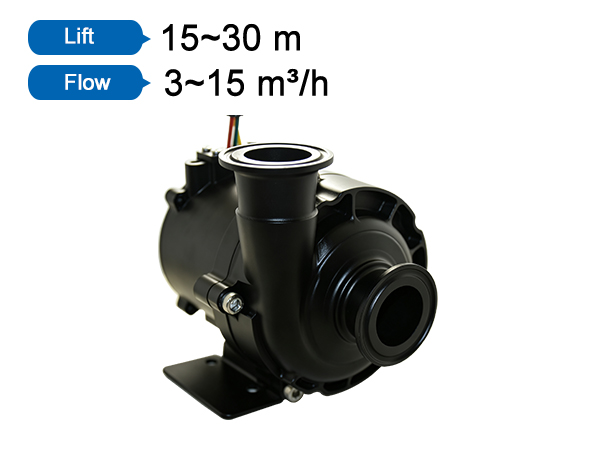
Flow is the sum of many rack demands, measured in m³/h. The SP8/20-0.8 (380 V, 3–15 m³/h, 15–30 m, 800 W) and the larger SP8/30-1.1 (380 V, 3–17 m³/h, 17–32 m, 1100 W) cover small and mid-size distribution circuits.
Head comes from distance and components, not cold plates — long pipe runs and filters need sustained multistage pressure.
380 V three-phase power is already on site, so large kilowatt loads distribute efficiently.
How the Two Tiers Work Together
Modern liquid-cooled halls use both. The facility AC pump feeds the distribution network at the manifold; each rack CDU closes its own loop with a DC pump. This two-stage design decouples the building circuit from the rack circuit, so a problem at one rack does not ripple through the hall. The market is moving in exactly this direction: the data center liquid cooling market is forecast to grow from USD 6.77 billion in 2026 to USD 18.79 billion by 2031, a 22.65% CAGR (Mordor Intelligence), and that growth pulls demand for both pump classes at once.
FAQ
Q: Which pump is better — DC or AC?
A: Neither is universally better. Brushless DC pumps suit rack-level CDUs and server loops; AC multistage pumps suit facility distribution. Choose by the tier your pump serves.
Q: Can I use a DC pump for facility distribution?
A: Not practically. Facility circuits need m³/h flows over long distances, which low-voltage DC pumps (rated in L/min, tens of watts) cannot deliver.
Q: Can I use an AC multistage pump inside a rack CDU?
A: No. Rack loops are short and compact, and a 380 V, multi-hundred-watt pump would be oversized, inefficient, and impossible to package.
Q: What voltage should a rack CDU pump run on?
A: Match the rack: 12 V for legacy nodes, 24 V for most current racks, 48 V for OCP and AI architectures.
Q: Does pump choice affect PUE?
A: Yes. Pump efficiency and right-sizing directly affect PUE, which is why variable-speed DC pumps at rack level and well-matched AC pumps in the plant both matter.
DC and AC Cooling Pumps from Shenpeng Technology
Shenpeng Technology supplies both sides of the comparison: brushless DC pumps for rack-level CDUs, including the P4552 (24 V, 11 L/min, 11 m, 28 W) and P6092 (24 V, 25 L/min, 27 m, 88 W), and 380 V AC multistage SP-series pumps for facility distribution, including the SP8/20-0.8 (3–15 m³/h, 15–30 m, 800 W) and SP8/30-1.1 (3–17 m³/h, 17–32 m, 1100 W). Contact our engineering team with your loop layout — we will map out which pump class belongs at each tier of your data center cooling pump design.
- DC vs AC Cooling Pumps for Data Centers: A Complete Comparison
- CDU Pump Selection Guide: Flow Rate, Head, and Power for Rack-Level Cooling
- How to Choose the Right Data Center Liquid Cooling Pump for Your CDU
- Distribution in Water Heater Mattresses: Why BLDC Pumps Ensure Uniform Heating
- How BLDC Pumps Ensure Precise Flow in Water Dispensers
- Why BLDC Pumps Are Essential for Smart Toilets
- The Critical Role of Automotive Electronic Water Pumps in New Energy Vehicle Battery Thermal Management
- Noise Control Technology for Smart Toilet Water Pumps: Enhancing Quiet Operation in Modern Bathrooms
- Unveiling the Working Principle of Automotive Electronic Water Valves
- Comparative Analysis of Liquid-Cooled Pumps vs. Air-Cooled Systems for EV Charging Stations